
The Question Millions Are Asking
Have you ever stood under a night sky and felt something you couldn’t name? You felt small yet connected, insignificant yet deeply part of something vast. That feeling has a name. It is called spirituality.
Millions of people search for the meaning of spirituality every single year. Yet most definitions leave people more confused than before. Some tie it exclusively to God. Others link it to yoga mats and incense sticks. The truth is far richer and more personal than either of those pictures.
Spirituality is not a trend. It is one of the oldest and most universal aspects of the human experience. Ancient civilizations built temples around it. Modern neuroscientists study it in brain scans. Psychologists measure its effects on mental health. And ordinary people, from every culture and background, feel its pull every single day.
Whether you are religious, atheist, or somewhere in between, spirituality speaks to something in you. It asks the questions that never go away: Who am I? Why am I here? What truly matters? These are not questions you can Google. They are questions that require a journey inward.
This guide dives deep into the meaning of spirituality, its many forms, its science-backed benefits, and its relationship with religion. By the end, you will have a clear, grounded understanding of what spirituality is and what it can mean for your life.
Key Takeaways
- Spirituality is a personal search for meaning, connection, and purpose that transcends the purely physical and material dimensions of life.
- Spirituality and religion are not the same thing. You can be deeply spiritual without belonging to any organized religion.
- Research consistently links spirituality to better mental health, lower rates of depression, stronger relationships, and even reduced mortality.
- A spiritual awakening is a profound shift in perspective that makes a person more empathetic, generous, and connected to others.
- Spirituality can be practiced through meditation, prayer, time in nature, creative expression, mindfulness, and many other accessible daily habits.
What Is Spirituality? The Core Meaning
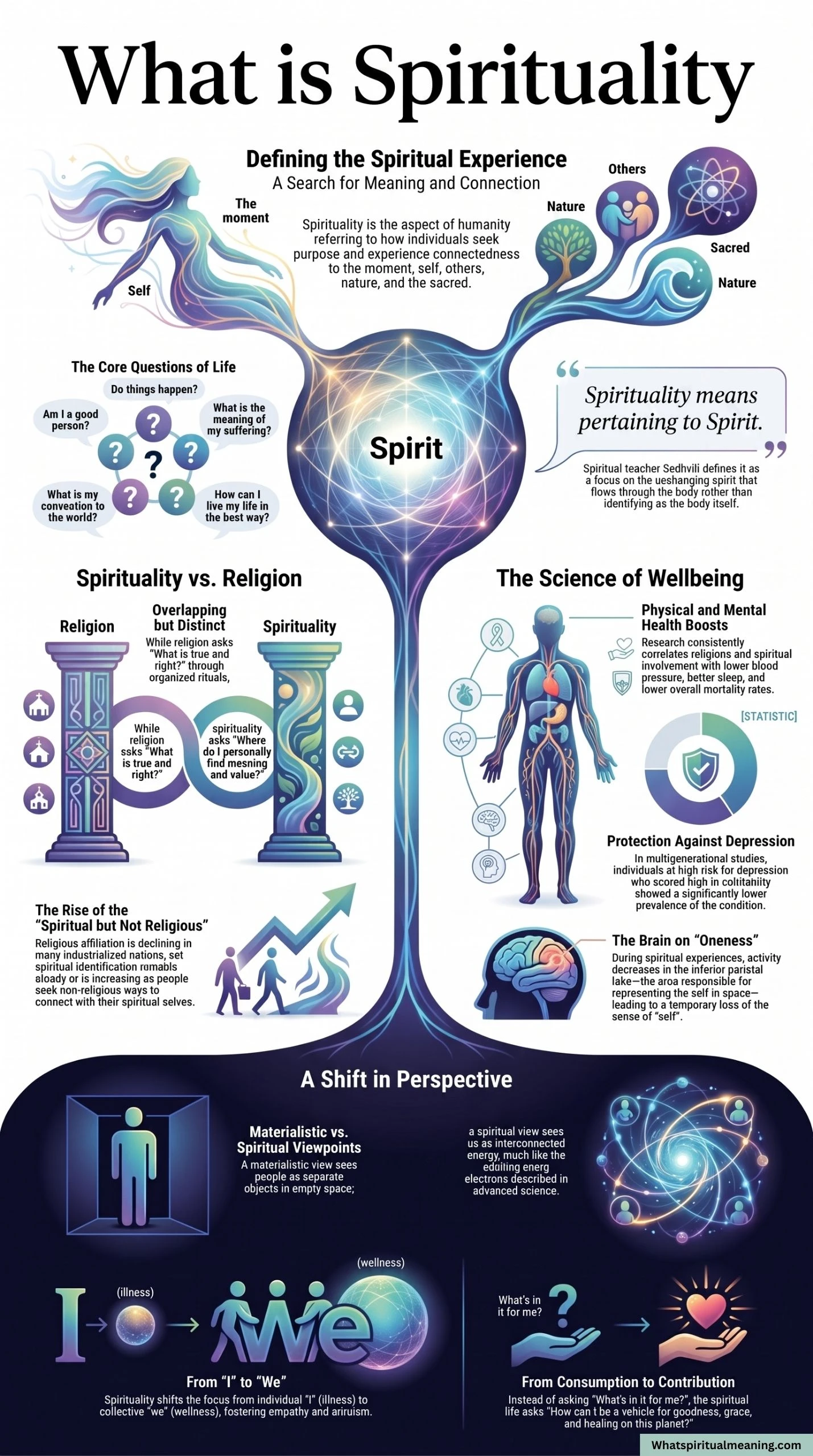
Spirituality is one of those words that carries enormous weight and yet resists a single, clean definition. That is not a flaw. It is actually part of what makes spirituality so powerful and so deeply human.
At its most fundamental level, spirituality is the search for meaning, purpose, and connection with something greater than yourself. That “something greater” takes different shapes for different people. For some, it is God. For others, it is the universe, nature, humanity, or an inner truth that goes beyond the physical world.
Christina Puchalski, MD, Director of the George Washington Institute for Spirituality and Health, defines it precisely: “Spirituality is the aspect of humanity that refers to the way individuals seek and express meaning and purpose and the way they experience their connectedness to the moment, to self, to others, to nature, and to the significant or sacred.”
That definition is powerful because it is inclusive. It does not require a church membership card. It does not demand a specific set of beliefs. Instead, it points to a universal human impulse, the desire to feel that your life matters and that you are connected to something beyond your own daily concerns.
Researchers Mario Beauregard and Denyse O’Leary, authors of The Spiritual Brain, add another layer. They describe spirituality as “any experience that is thought to bring the experiencer into contact with the divine.” Notice the emphasis on experience. Spirituality is not primarily intellectual. It is something you feel in your bones.
Catholic educator Regina Coll describes it beautifully as an “awareness of the ‘more than meets the eye'” in our daily lives. You have felt this. It happens when music moves you to tears for no logical reason. It happens when you hold a newborn baby and feel awe at the miracle of life. And, it happens when grief strips away everything superficial and leaves you face to face with what truly matters.
Brother David Steindl-Rast, a Benedictine monk, summarized it best: spirituality is not a separate penthouse department of life. It is “a vital awareness that pervades all realms of our being.” Wherever you come alive, that is where you are spiritual.
Spirituality vs. Religion: What Is the Real Difference?
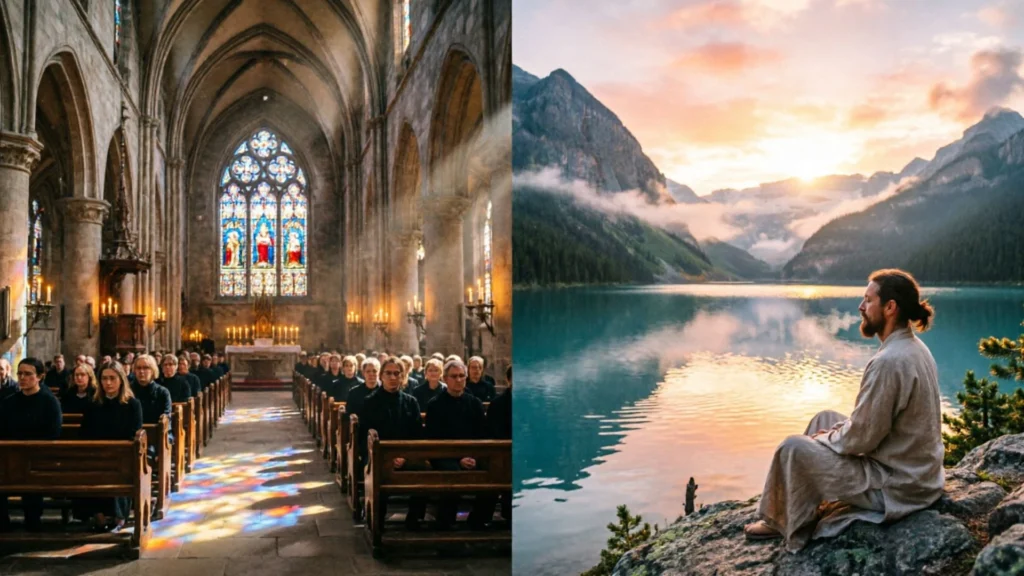
This is one of the most important distinctions you need to understand. Spirituality and religion are related, but they are not the same.
Think of it this way. Religion is like a structured game of football. There are rules, a field, a referee, and a team. The structure provides guidance, community, ritual, and tradition. Religion includes organized beliefs, sacred texts, acknowledged deities, and shared practices within a community. Christianity, Islam, Hinduism, Buddhism, and Judaism are all religions. Each has its own doctrines, traditions, and institutions.
Spirituality is more like kicking a ball freely in an open park. There are no mandatory rules, no fixed field, no referee. You still experience the essence of the game. You feel joy, movement, and freedom. Spirituality has to do with an individual’s personal sense of peace, purpose, and connection. It involves developing beliefs about the meaning of life and one’s relationship with others, without necessarily following a prescribed set of doctrines.
The relationship between the two is best understood as two overlapping circles. Some people are both religious and spiritual. Their faith community deepens their inner life. Some people are religious but not spiritual, following rituals without much inner engagement. Some are spiritual but not religious, pursuing meaning and connection outside any institution. And some are neither.
In religion, the core questions are: What is true? What is right? In spirituality, the core questions are more personal: Where do I find meaning? How do I connect with something larger than myself?
Bede Griffiths, a Christian monk who spent decades in India, offered a memorable image. He spread out his hand and said the separate fingers are like different religions, each distinct in its teachers, texts, rituals, and dogmas. But if you trace each finger to its source, to the palm of the hand, all the religions come together. That common source, that underground river running beneath all traditions, is spirituality.
Where Does Spirituality Come From?
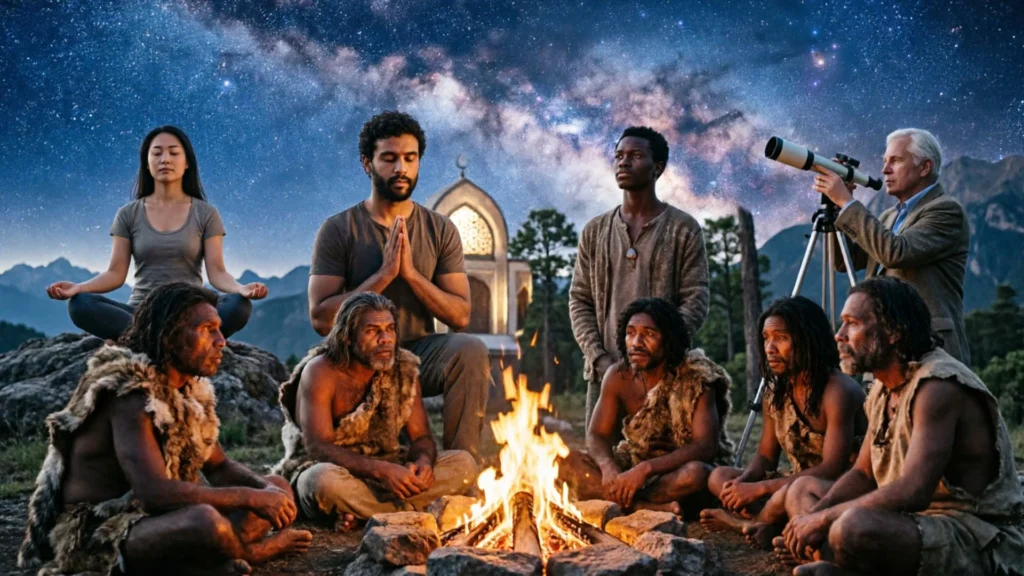
Spirituality appears to be woven into human nature itself. Research finds that even declared religious skeptics cannot fully suppress a sense that there is something greater than the physical world they can see and measure. The instinct toward transcendence runs deep.
Evolutionary psychologists suggest that as human beings mastered tools and developed a sense of their own agency, they naturally applied that thinking to the larger world around them. The idea of forces or beings responsible for creation took hold. This animistic belief gave birth to religion and spiritual practice across every known culture in human history.
From a neurological angle, the story gets even more fascinating. Studies on the brain show that spiritual experiences produce measurable changes in brain activity. When people describe moments of feeling oneness, connection to a higher power, or a sense of the infinite, they show reduced activity in the inferior parietal lobe, the region typically active when a person situates themselves in space and time. In other words, during genuine spiritual experiences, the brain temporarily releases the sense of separate self.
From a biblical perspective, the capacity for spirituality is tied to human dignity. Genesis 1:27 states that human beings are made in God’s image, which gives them the unique capacity for spiritual awareness, moral reasoning, and relationship with the divine. Animals act primarily on instinct. Human beings can choose to pursue values, meaning, and connection that go far beyond physical survival.
Jungian therapist Jeremiah Abrams describes spirituality as a “holy longing, a yearning to know the meaning of our lives.” That longing does not feel invented. It feels like something already present in you, waiting to be acknowledged.
7 Core Dimensions of Spirituality (What It Really Involves)
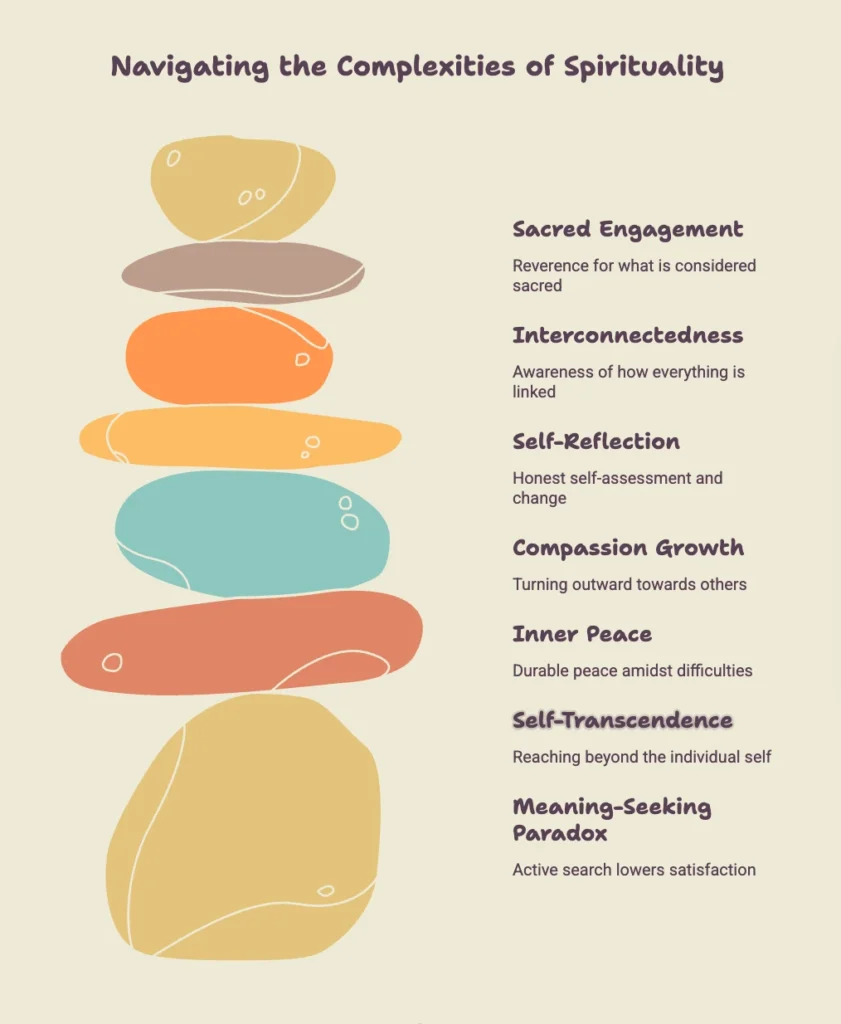
Spirituality is not a single thing. It is a multidimensional experience that touches every area of human life. Here are seven core dimensions that define what spirituality truly involves.
1. The Search for Meaning and Purpose
At the heart of spirituality is the relentless human need for meaning. You want to know that your life matters. You want to understand why you suffer, why you love, and what you are supposed to do with the years you have. Psychiatrist Viktor Frankl, a Holocaust survivor, wrote powerfully about this in Man’s Search for Meaning. He argued that the will to find meaning is the deepest human motivation, even stronger than the will for pleasure or power.
Frankl observed something counterintuitive in his research. Those who search actively for meaning often report lower life satisfaction. Meaning, he argued, must arise as a byproduct of living with purpose and commitment, not as something you chase directly. Spirituality creates the conditions in which meaning can emerge organically, through practice, relationship, reflection, and service.
2. Connection to Something Greater Than Yourself
Spirituality always involves a reaching beyond the borders of the individual self. This connection can take the form of a relationship with God, a sense of oneness with nature, a profound bond with a community, or an awareness of being part of a larger cosmic story. This sense of transcendence is what separates spiritual experience from mere self-improvement.
Research published in neurological studies confirms this dimension. When people report experiences of unity or connection with the infinite, their brain scans show a temporary suspension of the neural processes that maintain the boundary between “self” and “other.” The subjective experience of spiritual connection has a measurable, objective correlate in the brain. Spirituality is not just a feeling. It is a real and significant shift in consciousness.
3. Inner Peace and Emotional Wholeness
One of the most consistent fruits of spiritual practice is a deep and durable inner peace. This is not the shallow peace of having no problems. This is the kind of peace that holds even when circumstances are difficult. The Apostle Paul described it as “the peace of God that surpasses all understanding” (Philippians 4:7).
This peace comes from anchoring your identity and sense of worth in something that cannot be taken from you. Material success can disappear overnight. Relationships can end. Health can fail. But a spiritual foundation provides stability that external events cannot easily destroy. Spiritual health, like physical and mental health, is a crucial component of overall wellbeing.
4. Compassion and Generosity Toward Others
Spiritual growth consistently produces a turning outward, toward others. Research finds that people who undergo intense spiritual experiences become significantly more altruistic than they were before. They are more likely to donate to strangers, volunteer their time, and act with compassion even when it costs them something personally.
This is not coincidental. When spirituality deepens your sense of connection to all life, the suffering of others begins to feel more real and more urgent. The separation between “me” and “them” becomes thinner. Empathy grows naturally from the same soil as spiritual awareness.
5. Honest Self-Reflection and Personal Transformation
Authentic spirituality is never comfortable in a shallow way. It challenges you to look honestly at yourself, to recognize your weaknesses, patterns, and unresolved wounds, and to pursue genuine change. Psychotherapist Molly Young Brown writes that spiritual growth involves “expanding awareness, strengthening your center, clarifying your purpose, and transforming your inner demons.”
This dimension of spirituality overlaps significantly with emotional health. Mindfulness practice, widely recommended in both spiritual and psychological contexts, trains you to observe your inner landscape with honesty and without judgment. Over time, this honest self-awareness creates the conditions for real transformation.
6. A Sense of Interconnectedness With All Life
Spirituality cultivates a deep awareness of how interconnected everything is. You are not an isolated unit. You are woven into a web of relationships, ecosystems, histories, and shared human stories. This awareness naturally produces humility. It reduces the kind of self-centered thinking that fuels anxiety, entitlement, and moral blindness.
Alan Jones, former dean of Grace Cathedral in San Francisco, distills spirituality to its simplest form: “the art of making connections.” That phrase carries tremendous depth. To be spiritual is to see the threads that link you to other people, to the natural world, to those who came before you, and to those who will come after.
7. Engagement With the Sacred or Transcendent
Finally, spirituality involves some form of engagement with what you consider sacred. For religious people, this means worship, prayer, scripture, and sacrament. For non-religious spiritual seekers, the sacred might be encountered in music, art, the beauty of nature, deep silence, or profound human love.
The sacred is whatever you treat with ultimate reverence and attention. It is the dimension of experience that feels most real and most important, the dimension that gives everything else its meaning. When you are in the presence of what you consider sacred, you feel most fully alive.
Types of Spirituality: Different Paths to the Same Depth
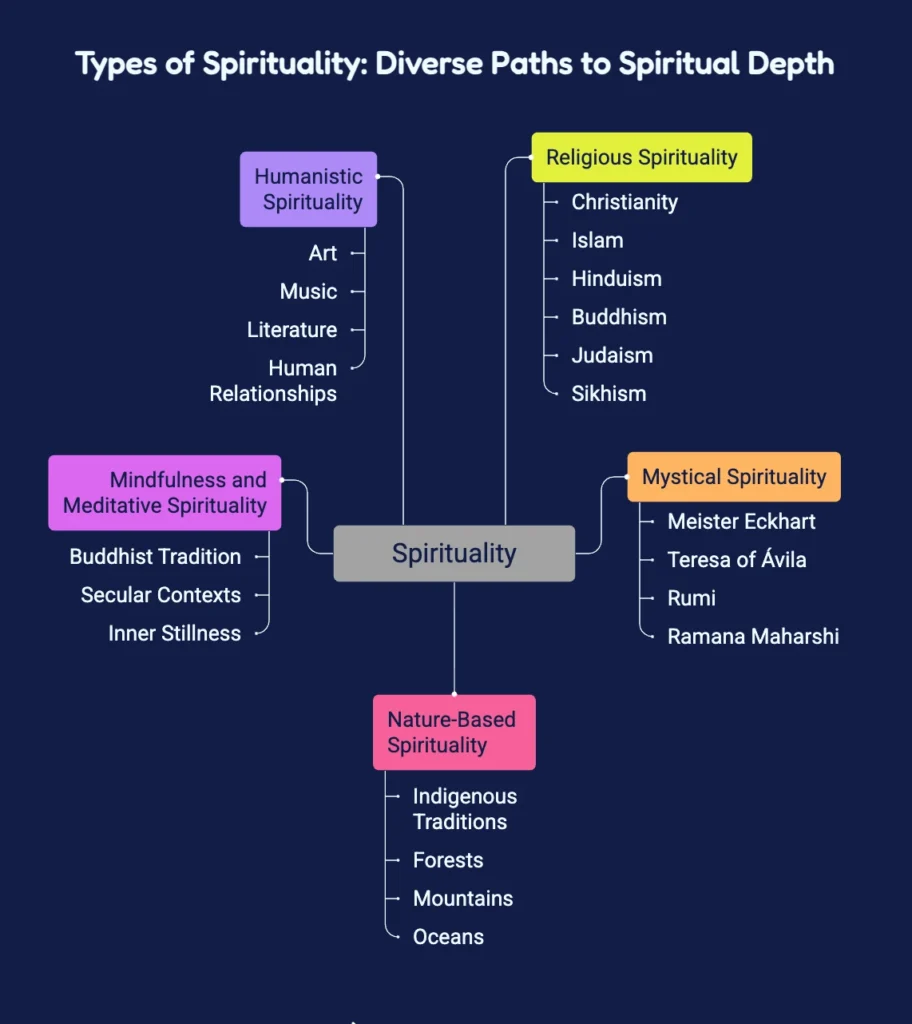
Spirituality is not one-size-fits-all. It expresses itself through many different paths, and no single path is the only valid one.
Religious spirituality is the most widely recognized form. It is practiced within organized traditions such as Christianity, Islam, Hinduism, Buddhism, Judaism, and Sikhism. These traditions provide structure, community, sacred texts, and time-tested practices that have guided billions of people over thousands of years.
Mystical spirituality focuses on direct, personal experience of the divine or the ultimate reality. Mystics across traditions, from Christian contemplatives like Meister Eckhart and Teresa of Ávila to Sufi poets like Rumi and Hindu sages like Ramana Maharshi, emphasize inner transformation through direct encounter with the sacred, often beyond words or doctrines.
Nature-based spirituality locates the sacred in the natural world. Indigenous spiritual traditions around the world have long practiced a deep reverence for the earth, its cycles, and its living systems. Many modern people find their deepest sense of connection and awe outdoors, in forests, mountains, oceans, and open skies.
Mindfulness and meditative spirituality prioritizes the cultivation of present-moment awareness as a spiritual practice. Rooted in Buddhist tradition but widely adopted in secular contexts, mindfulness teaches you to observe your thoughts, emotions, and sensations without judgment. This inner stillness becomes the ground from which deeper spiritual insight grows.
Humanistic spirituality centers on the sacred value of human life, creativity, and community. Art, music, literature, and deep human relationships become the primary vehicles of spiritual experience. This form of spirituality is common among atheists and agnostics who nonetheless experience profound meaning, beauty, and transcendence.
Spiritual Awakening: What It Is and What It Does to You
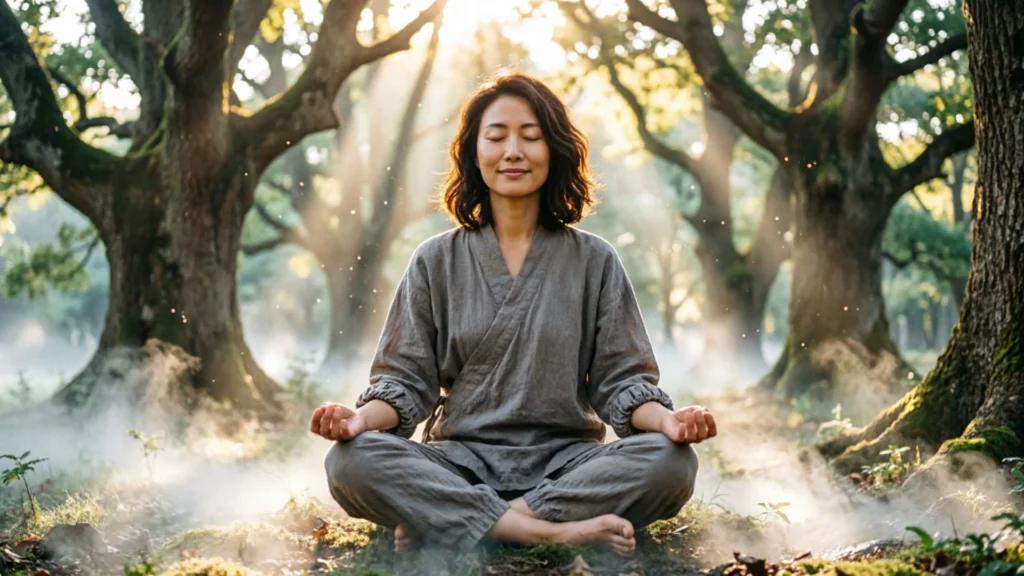
The term spiritual awakening gets used frequently, but it refers to something specific and significant. A spiritual awakening is a profound shift in perception and identity after which a person sees the world, themselves, and their relationship to others in a fundamentally new way.
People who describe spiritual awakenings often report a sudden or gradual dissolution of the walls between self and other. Things that seemed overwhelmingly important before, like social status, material accumulation, or the opinions of others, lose their grip. In their place comes a deep sense of peace, compassion, and purpose.
Research supports the transformative power of these experiences. Studies consistently show that people who undergo profound spiritual experiences become less materialistic, more empathetic, more generous, and more oriented toward service. Psychologists note that intense experiences of suffering or loss often catalyze spiritual awakenings. The ego, stripped of its usual defenses, opens to something larger.
A spiritual awakening does not require a dramatic event. It can begin quietly, with a growing dissatisfaction with a life lived only on the surface, a nagging sense that there is more to existence than what you currently see. Many people describe waking up as a gradual process of deepening awareness, punctuated occasionally by moments of sudden clarity.
It is important to note that a spiritual awakening, while profound, is not a prerequisite for living a spiritual life. Spirituality is a daily practice, not a single destination.
The Proven Benefits of Spirituality: What Science Says
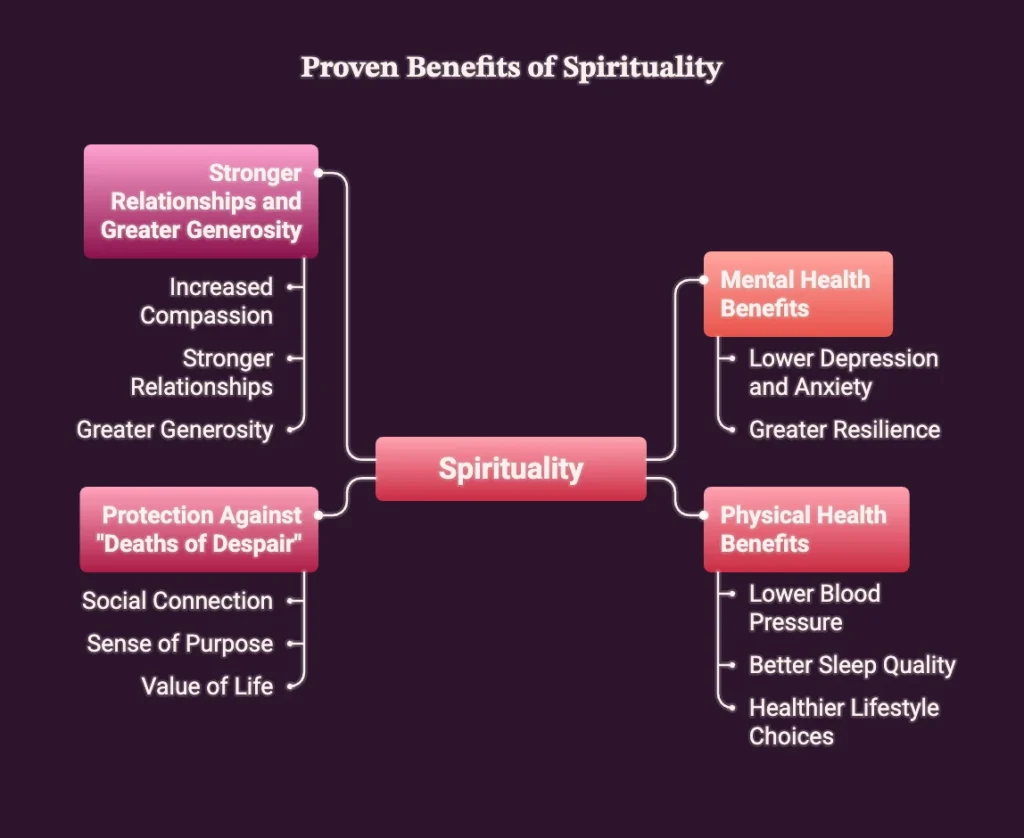
The benefits of spirituality are not vague or anecdotal. A large and growing body of research has documented the concrete effects of spiritual practice on health, relationships, and mental wellbeing.
Mental Health Benefits
Research consistently links higher levels of spirituality with lower rates of depression and anxiety. In a multigenerational study of depression, subjects considered at highest risk who scored highest on measures of religiosity and spirituality showed a significantly lower eventual prevalence of depression. Further neurological research suggests that spiritual practices may produce actual changes in brain structure, including increased serotonin levels and a thickening of the cerebral cortex, which protects against depression.
People with strong spiritual lives also demonstrate greater resilience in the face of stress. They cope better with illness, loss, and life transitions. They are more likely to find meaning in difficult experiences rather than being crushed by them.
Physical Health Benefits
The physical benefits are equally compelling. Research finds that spiritual and religious involvement correlates with better physical health outcomes, including lower blood pressure, better sleep quality, healthier lifestyle choices such as reduced smoking and alcohol consumption, and an overall lower mortality rate.
These benefits likely flow through several pathways. Social connection provided by spiritual communities reduces loneliness, which is itself a major risk factor for physical illness. Reduced stress through spiritual practice lowers cortisol levels, protecting the cardiovascular and immune systems. A greater sense of purpose motivates people to care for their bodies.
Protection Against “Deaths of Despair”
One of the most striking research findings concerns what epidemiologists call “deaths of despair“: suicide, drug overdose, and alcohol poisoning. People who regularly attend religious services appear significantly less vulnerable to all three. The reasons likely include greater social connection, a deeper sense of purpose, and a framework that emphasizes the value of life.
The flip side is also revealing. Research has found that those who avoid all forms of spiritual or religious thinking and cannot identify meaningful patterns in the world around them show higher rates of depression and anhedonia, the inability to feel pleasure. The complete absence of transcendence appears to carry its own psychological cost.
Stronger Relationships and Greater Generosity
Higher levels of spirituality are linked to increased compassion, stronger relationships, and greater generosity. Spiritual people tend to invest more in others and experience greater satisfaction in their relationships. They are more likely to volunteer, donate, and act with kindness toward strangers.
This makes intuitive sense. When spirituality deepens your sense of connection to all life, other people’s needs feel more real and more urgent. The boundaries of “self” become more permeable. Generosity becomes natural, not forced.
Spirituality and Emotional Health: A Deep Connection
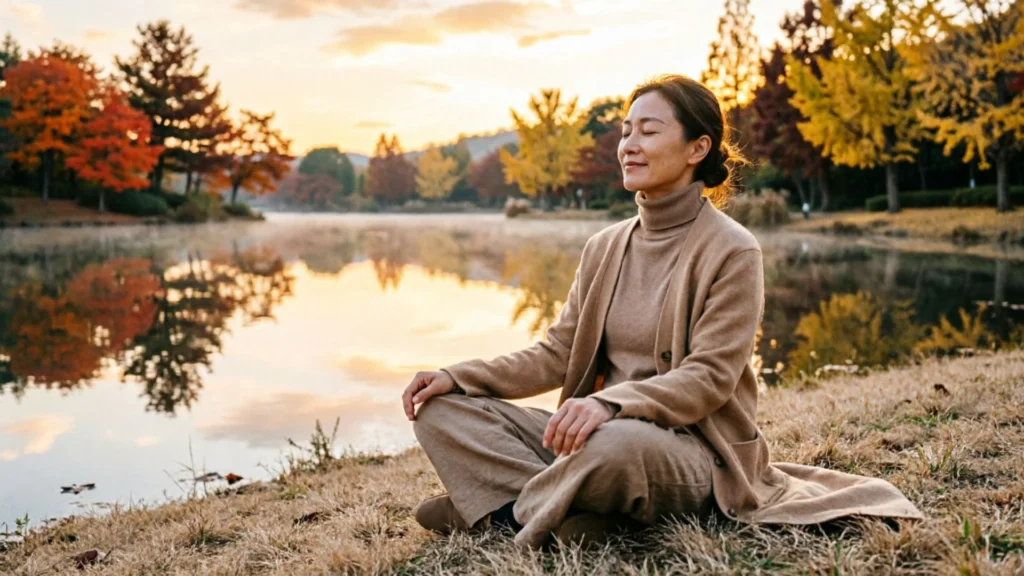
Spiritual wellbeing and emotional wellbeing are deeply intertwined. They are distinct dimensions of the human person, but they consistently influence and reinforce each other.
Spirituality is fundamentally about seeking a meaningful connection with something bigger than yourself. This search produces positive emotional states: peace, awe, gratitude, contentment, and acceptance. These are not just pleasant feelings. They are foundational to mental health and human flourishing.
Emotional health, in turn, cultivates the openness and inner stability that makes genuine spiritual experience possible. A person who is overwhelmed by anxiety, shame, or unprocessed grief finds it very difficult to be present to the sacred dimensions of life. Working on your emotional health clears the ground for spiritual growth.
Mindfulness practice sits at the intersection of the two. It trains you to be present to your own inner experience with curiosity and kindness. This is simultaneously a psychological skill and a spiritual discipline. Through mindfulness, you can discover how spirituality manifests naturally in your own life, in the moments of awe, gratitude, and deep presence that you might otherwise rush past.
How to Develop Your Spirituality: Practical Pathways
Spirituality is not passive. It develops through intentional practice. You do not have to join a monastery or attend services every week. Spiritual development happens wherever you choose to show up with full presence and genuine attention.
Meditation and contemplative prayer are among the most direct and well-researched methods. Regular meditation trains the mind to release its grip on surface-level thoughts and open to a deeper stillness. Even ten to fifteen minutes daily produces measurable benefits over time.
Time in nature is deeply restorative for spiritual life. The natural world has a way of dissolving the ego’s preoccupations and opening you to a sense of wonder and interconnectedness. Forests, oceans, mountains, and open skies have been recognized as sacred spaces across virtually every human culture.
Creative expression through art, music, writing, or dance can be a profoundly spiritual act. When you create from a place of genuine feeling and full presence, you touch something in yourself that ordinary conversation cannot reach. Many people describe their most intense spiritual experiences happening in the act of creating.
Service to others is one of the most reliable paths to spiritual growth. When you give your time, energy, or resources to someone who cannot repay you, your sense of separate self begins to soften. Generosity consistently produces joy and meaning that materialism cannot match.
Reading sacred texts and wisdom literature across traditions exposes you to the distilled insights of men and women who devoted their lives to the spiritual quest. The Bible, the Upanishads, the Tao Te Ching, the poetry of Rumi, and the writings of mystics across centuries all carry wisdom that speaks to the depths of human experience.
Community and relationships matter enormously. You do not have to practice spirituality alone. Being in the company of others who share your commitment to depth and meaning accelerates your own growth. Spiritual community provides accountability, encouragement, and the particular kind of grace that comes from being truly known.
Spirituality in Different World Traditions
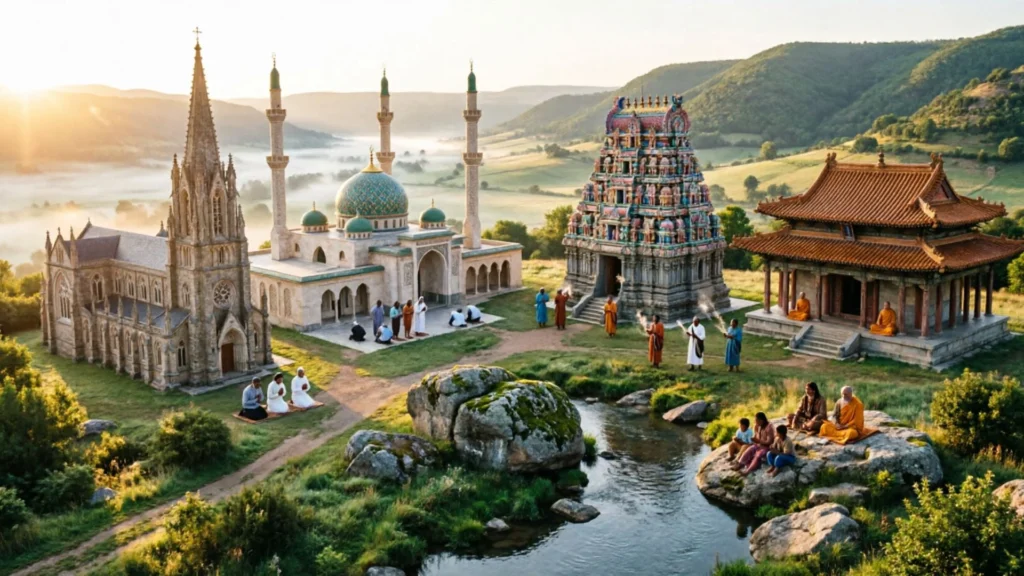
One of the most remarkable facts about spirituality is its universality. Every major human civilization, in every part of the world, has developed spiritual practices and beliefs. The forms differ enormously. The underlying hunger is identical.
In Christianity, spirituality centers on a personal relationship with God through Jesus Christ, sustained by prayer, scripture, sacrament, and community. The goal is transformation into Christlike love, expressed through service, forgiveness, and sacrificial care for others.
In Islam, the word for spirituality is closely linked to taqwa, a state of consciousness and reverence before God. The Sufi tradition within Islam places particular emphasis on the inner dimensions of faith, seeking direct mystical experience of divine love and unity through prayer, contemplation, and music.
Hindu spirituality encompasses an enormous diversity of practices and philosophies. The Vedantic tradition emphasizes the ultimate identity of the individual soul (atman) with the universal consciousness (Brahman). Yoga, in its original meaning, is a spiritual discipline aimed at this realization.
Buddhist spirituality begins with the recognition of suffering and its causes, and offers an Eightfold Path of ethical living, meditation, and wisdom as the way to liberation. The goal is not union with God but the dissolution of the illusion of a separate self, and the consequent arising of compassion for all beings.
Indigenous and earth-based spiritualities across the Americas, Africa, Oceania, and Asia share a reverence for the living earth, the cycles of nature, and the ancestral wisdom of those who came before. These traditions tend to emphasize relationship: with the land, with ancestors, with community, and with the spirit world.
Common Misconceptions About Spirituality
Several persistent misconceptions keep people from engaging honestly with spirituality. They deserve to be addressed directly.
Misconception 1: Spirituality requires a belief in God. This is not accurate. Many forms of spirituality, including Buddhist practice and various humanistic traditions, do not involve belief in a personal God. Spirituality requires openness to transcendence and meaning, not necessarily theism.
Misconception 2: Spiritual people are naive or anti-intellectual. In fact, some of the greatest intellectuals in human history, including physicists, philosophers, and psychologists, have described themselves as deeply spiritual. Albert Einstein famously described a sense of cosmic religious feeling as the source of his scientific curiosity.
Misconception 3: You need to be perfectly calm and peaceful to be spiritual. Spirituality is not about having no problems or never feeling negative emotions. It is about engaging with life’s full range of experiences from a place of deeper awareness and meaning.
Misconception 4: Spirituality is self-centered. Authentic spirituality consistently moves people away from self-centeredness and toward greater compassion and generosity. The research on this is clear and consistent.
Misconception 5: Spirituality is about escaping the world. True spirituality does not lead to withdrawal from life. It leads to more engaged, more compassionate, and more courageous participation in the world. Latin American theologian Leonardo Boff describes spirituality as the attitude that “puts life at the center and defends and promotes life.”
Spiritual Health: The Often Forgotten Dimension of Wellbeing
Modern healthcare frameworks increasingly recognize spiritual health as a legitimate and important dimension of overall wellbeing, alongside physical and mental health. The World Health Organization has acknowledged that a complete understanding of health must include the spiritual dimension.
Spiritual health does not mean religious observance, though it may include it. It means discovering what makes you genuinely alive and fulfilled, and giving adequate attention to those things. It means living with a sense of purpose that extends beyond your own immediate comfort. Also, it means maintaining connections to meaning, beauty, and transcendence in your daily life.
Many people neglect their spiritual health without realizing it. They focus entirely on physical fitness, career advancement, and material comfort, while the deeper questions of meaning and purpose go unaddressed. The result is often a nagging sense of emptiness, even when external circumstances are favorable. Spiritual hunger is real, and it will make itself known.
Taking care of your spiritual health is not a luxury. It is a fundamental act of self-care that benefits every other dimension of your life.
A Final Note
Spirituality is not a destination you arrive at after completing the right steps. It is a living, ongoing relationship with the deepest dimensions of your own life and the world around you.
You do not need to resolve every theological question before you can live spiritually. You do not need to choose between science and faith, between reason and mystery, between tradition and personal experience. Spirituality holds space for all of it. It asks only that you show up honestly, that you keep asking the questions that matter, and that you stay open to being surprised.
The great spiritual teachers across traditions agree on one thing: the examined life is worth living. Not because examination leads to certainty, but because the act of questioning, seeking, and attending to what is deepest in you makes you more fully human. It makes you more alive, more compassionate, and more capable of the kind of love that actually changes things.
Start where you are. Be honest about what you do not know. Attend to the moments when you feel most alive. Follow the thread of meaning wherever it leads. That is what it means to live spiritually. And it is available to you right now, exactly as you are.

Simu Wong Lee holds a Bachelor of Arts (BA) in Arts, Culture, and Mythology from the College of Humanities and Social Sciences at George Mason University. He is a passionate content writer specializing in arts, cultures, mythologies, religions, and spirituality. His work has been published on several websites, including Prayerverses and Spiritualmarker, where he shares well-researched, engaging, and insightful content that helps readers explore the deeper meanings behind beliefs, symbols, and traditions from around the world.